For first-time visitors to London, the Buckingham Palace Changing of the Guard is almost a must-do. The question is: how long does the Change of Guards ceremony actually last? What time does it start, and when should you arrive to get a good spot? Where should you stand to capture the full view of the palace, instead of just other people’s phones? Based on my two visits, this guide covers the latest guard change times and dates, the three main viewing and photography spots, crowd flow and walking routes, and shares real on-the-ground experience to help you decide whether it is worth making a special trip on your first visit to London.
Read Before Your Trip
UK City Guides:London|Liverpool
London Articles:Top Attractions|London Pass Guide|Day Trips From London|London Itinerary|London Transportation Guide|London for Seniors|Harrods|Buckingham Palace Changing of the Guard
Passes:London Pass|BritRail Pass|Euro Train Pass
Buckingham Palace:Get Your Guide|KLOOK
Westminster Abbey:Get Your Guide|KLOOK
Tower of London:Get Your Guide|KLOOK
London Eye:Get Your Guide|KLOOK
Day Trip to Windsor Castle, Stonehenge, and Bath:Get Your Guide|KLOOK
What Is the Buckingham Palace Changing of the Guard?
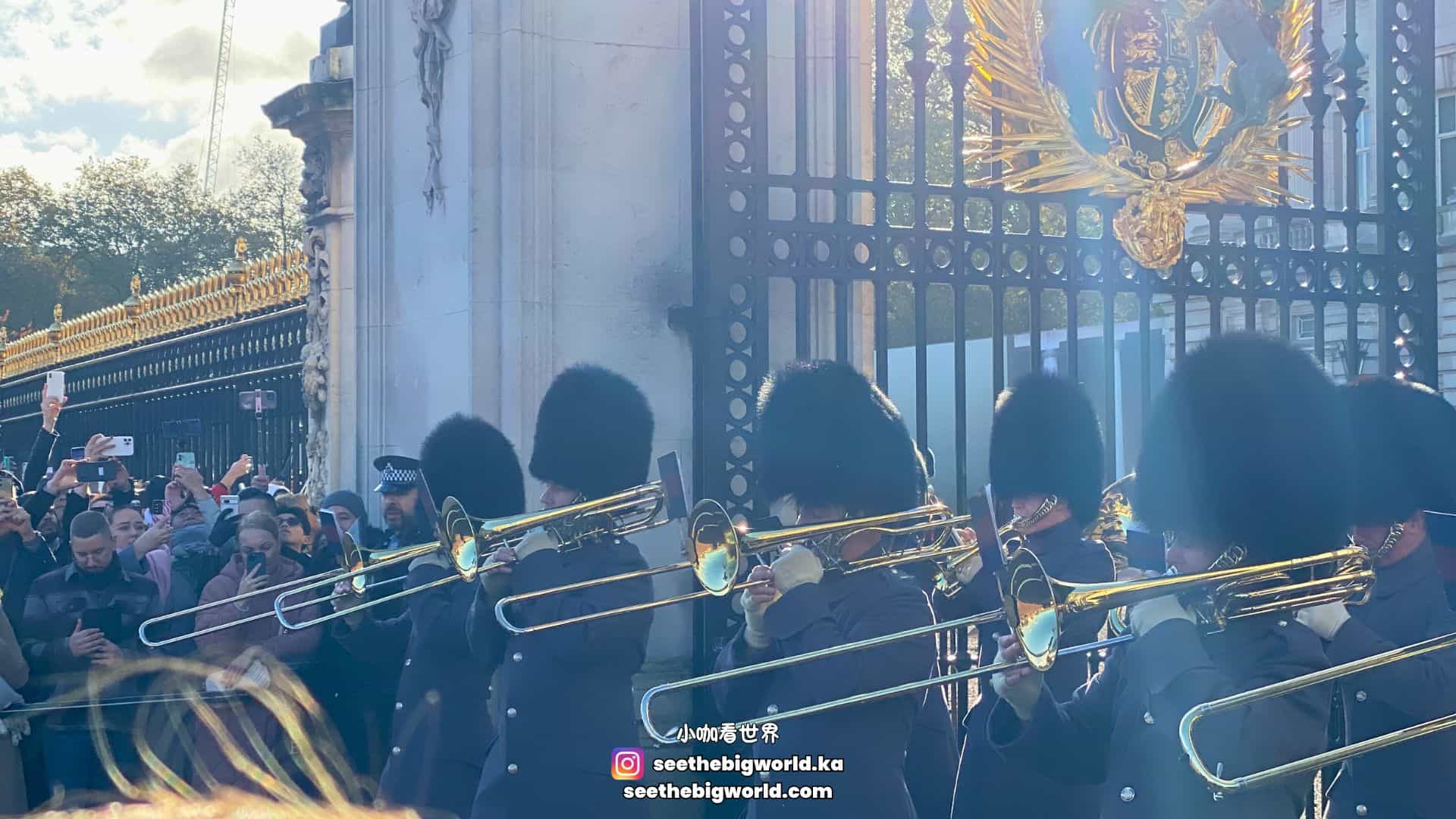
Royal Guards Overview
If you are looking for things to do in Londan, Buckingham Palace is something you can't miss! It is the main residence of the British monarch and hosts significant national ceremonies such as coronations, state visits, and state banquets. Originally built in 1703 as a private home for the Duke of Buckingham, it was purchased by George III in 1761 and converted into a palace, becoming the official residence of the British monarch. Key highlights of a visit include the Changing of the Guard ceremony and the state rooms open to the public during the summer.
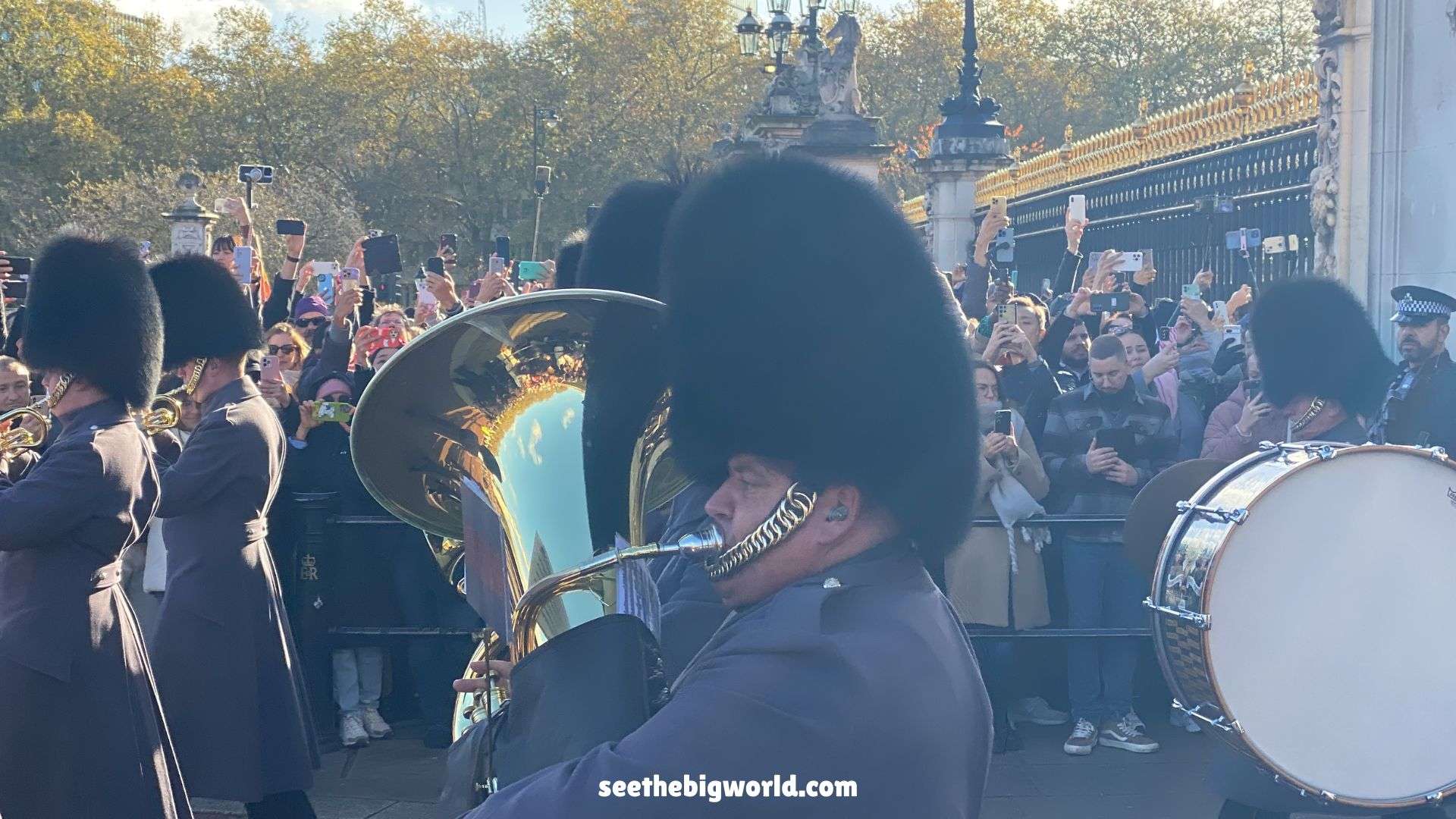
The Buckingham Palace Changing of the Guard is the formal ceremony where the King’s Guard hands over responsibility for guarding Buckingham Palace and St James’s Palace. Most of the guards belong to infantry regiments of the Household Division, such as the Grenadier Guards, Coldstream Guards, Scots Guards, Irish Guards and Welsh Guards. Their iconic red tunics and bearskin hats have become the defining image of the “British monarchy” for many people.
These guards are active-duty soldiers, not simply a performance troupe, and they still have military duties outside of ceremonial work. Stationing them at the palace and carrying out the handover in public is not only a continuation of tradition, but also a visible symbol that the monarchy remains closely linked with the armed forces.
Tourism & City Rituals
This 40–45 minute ceremony itself is free, but its role in the city’s tourism economy is very clear:
- It concentrates global visitors at a specific time and in a specific district
- It makes the surrounding Underground stations, souvenir shops, cafés and pedestrian flows highly predictable
- It guarantees London a recurring “very British but free to watch” image in almost all tourism media
For the city, it is a relatively low-cost way to maintain its brand. For travellers, it is a free experience that sits somewhere between a formal state ritual and a choreographed tourist performance.
Is It Worth A Special Trip?
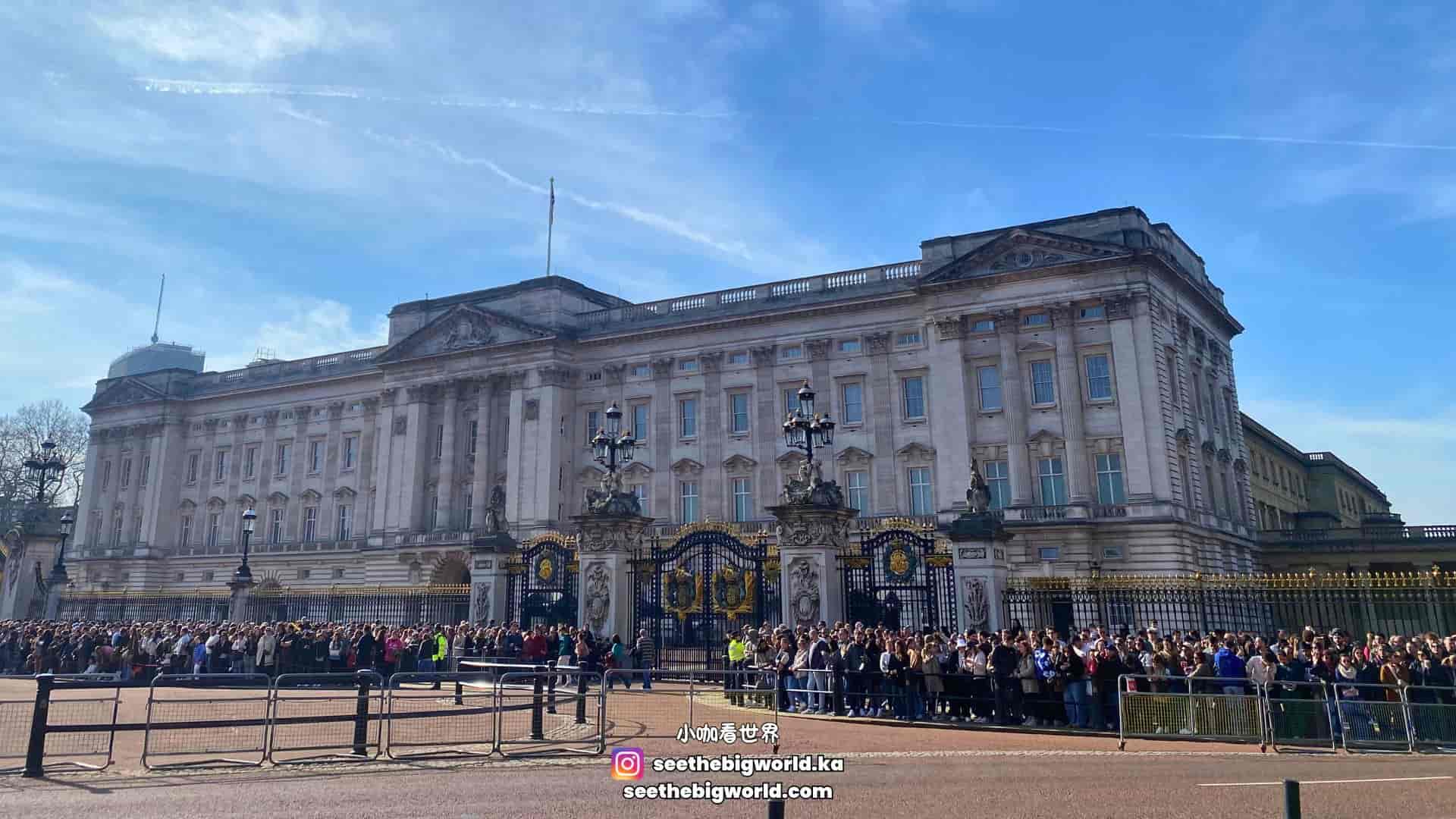
My Experience with Family
I lived in London for about two years and kept thinking, “I’ll go another time when I’m free.” In the end I procrastinated until I was about to move to another city before I finally set aside a day just to see the guard change. That day I only planned this one activity, arrived early to get a spot, and ended up almost in the second row right behind the railings. I could clearly see the guards’ steps, facial expressions and details of the ceremony. Visually, it was undeniably impressive.
Later, when my parents visited the UK, the only specific request from my father (who is over 70) was Buckingham Palace. This time, with an older parent, we did not fight for the very front. We stood further back, but for him, simply seeing the palace and feeling the atmosphere in person already felt “worth the effort”. The trade-off was that standing for such a long time was physically tiring. That day, apart from the ceremony, we only had a simple lunch around Westminster and took a few photos before heading back to rest.
By contrast, when my partner’s parents came to London, we had originally planned to include the guard change, but his mother was not interested in this type of ceremony, so we removed it and replaced it with relaxed walks and other sights. They actually enjoyed that version of the itinerary more.
First-Time Visitors: When to Go or Skip
You may want to include it in your plan if:
- It is your first time in London and you want to see the “textbook image” of Britain in person
- You enjoy ceremonies, marching and live military band music
- You do not mind arriving over an hour early to secure a spot and standing in a dense crowd
You may want to skip it if:
- You have very little patience for crowds and standing still
- You are only in London for one or two days and would rather prioritise museums, exhibitions or other experiences
- You have already seen similar large-scale military ceremonies in other countries and are not particularly interested in this type of event
In short, the guard change is essentially trading almost half a day for one set of “classic London” visuals. Whether it is worth it has less to do with how spectacular the ceremony is, and more to do with how much you personally care about the monarchy and ceremonial pageantry.
Time Line
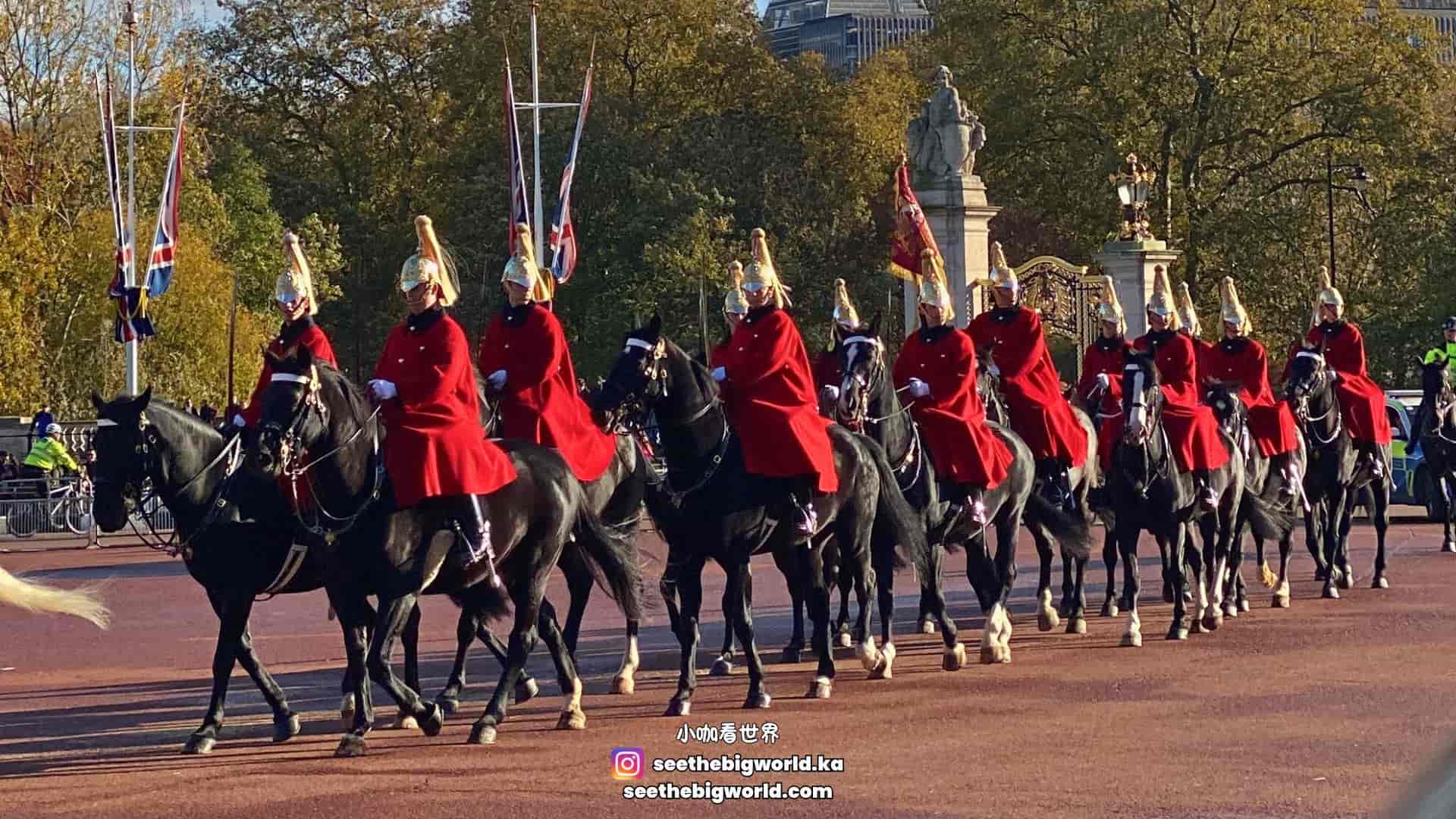
Start Time & Duration
The general timing is roughly as follows (based on recent arrangements):
- Around 10:30: units at each location begin forming up and marching
- Around 11:00: the main ceremony starts in the forecourt of Buckingham Palace
- Around 11:40: the ceremony ends and the troops begin to depart
Schedule varies by season:
- Traditional pattern: usually Mondays, Wednesdays and Fridays (sometimes also Sundays), with actual dates subject to adjustment
- Spring and summer peak season: sometimes increased to near “daily” or with extra events such as Sunday parades
How to Check the Schedule
As an official military and royal ceremony, the schedule can be adjusted or cancelled at short notice due to operational needs, state events or bad weather. In some cases, changes may only be confirmed shortly before the ceremony.
Recommended approach:
- 1–2 weeks before your visit, check the Official Schedule
- Check again in the week you plan to go (especially in winter or during major national events)
- If it is clearly raining heavily or the weather conditions are poor, be prepared for the possibility of a reduced or cancelled ceremony
When to Arrive
The rule is simple: the more you care about your view and photos, the earlier you should arrive.
- Summer peak season, weekends and holidays
- Try to arrive no later than 10:00
- If you want the front row at the railings or the central spot at Victoria Memorial, go before 9:30
- Off-peak weekdays (outside school holidays)
- Arriving around 10:15–10:30 usually still gets you a reasonable view
- However, if large tour groups show up at once, the area can fill up very quickly
Buckingham Palace State Rooms Summer Opening
In addition to the Changing of the Guard, the summer-only opening of the State Rooms is a highlight that is well worth adding to your plan. It is recommended to book a ticket for 12:30 or later, so you can enter straight after watching the ceremony.
- Opening Hours:
- State Rooms Inside the Palace:
- July-August: Daily 09:30 - 19:30 (Last entry: 17:15)
- September: Daily 09:30 - 18:30 (Last entry: 16:15)
- In winter, there are sometimes special guided tours available.
- State Rooms Inside the Palace:
- Book in Advance (Some tickets with free cancellation/discounts)
Route Map & Best Photo Spots
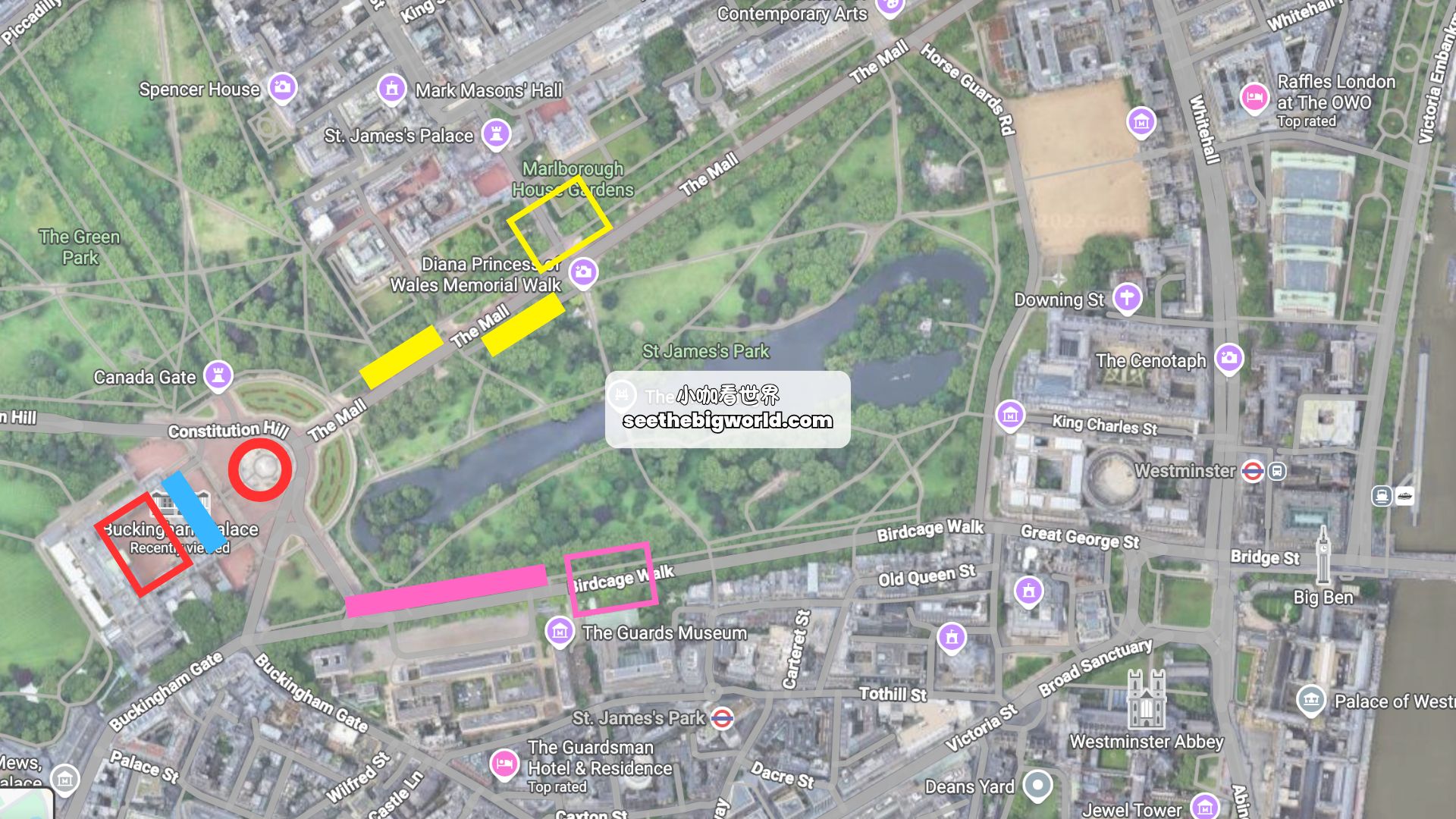
Map of the Changing of the Guard routes and viewing spots around Buckingham Palace. Each highlighted area will be explained in detail in the sections below.
How To Get to Buckingham Palace
The easiest way to reach Buckingham Palace is to take the Tube to Green Park Station (Piccadilly / Jubilee / Victoria lines). Exit via the main exit, walk across Green Park, and you will reach the front of the palace in about 7–10 minutes. The route is flat, well signposted, and is the most common choice for visitors.
Three Key Locations
The guard change does not take place “only in front of Buckingham Palace”. It actually spans three main locations:
- St James’s Palace
- The yellow hollow rectangle on the map above
- Some of the old guards are originally stationed here
- A typical scene is the troops forming up and being inspected in the courtyard before marching to Buckingham Palace
- Wellington Barracks
- The pink hollow rectangle on the map above
- The new guards depart from here, led by a military band
- The troops march along Birdcage Walk
- Buckingham Palace Forecourt
- The red hollow rectangle on the map above
- The main visual focus of the ceremony
- The old and new guards formally swap duties here, with the band playing and various formation changes taking place
Close-Ups: Front Railings
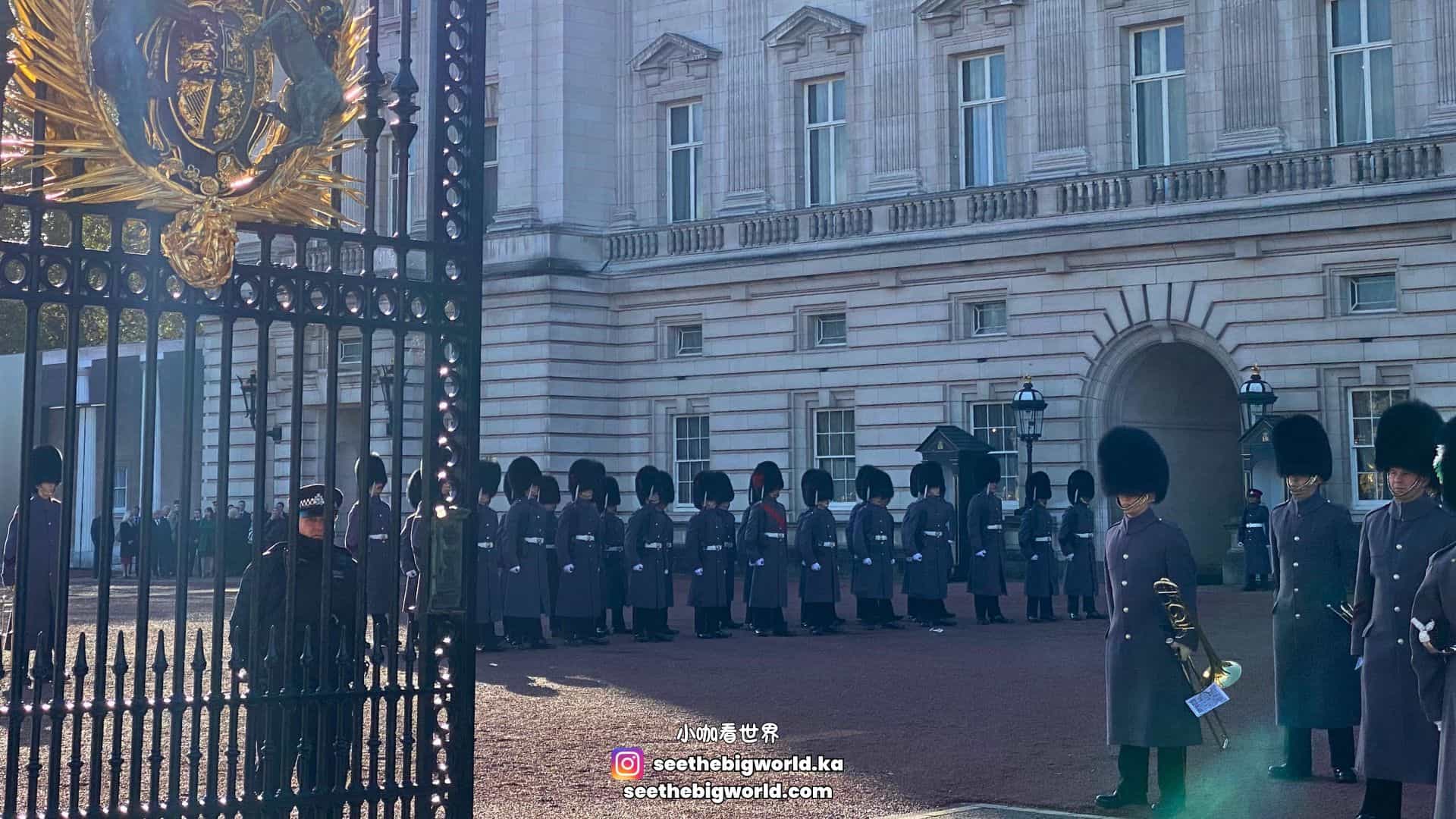
This is the most obvious viewing spot and also the most crowded.(The light blue rectangle on the map above)
- Pros:
- You can photograph the guards, band and formation changes at close range
- Your frame can include both the palace façade and the forecourt ceremony
- Cons:
- The railings will appear in your photos, so you need to compose carefully
- Once the front row fills up, you are likely to be shooting other people’s phones and arms
- Children and shorter visitors often have their view completely blocked
- Best For:
- First-time visitors who want maximum “ceremony” impact. The condition is that you are willing to arrive at least 45–60 minutes early to secure a spot.
Palace & Square: Victoria Memorial
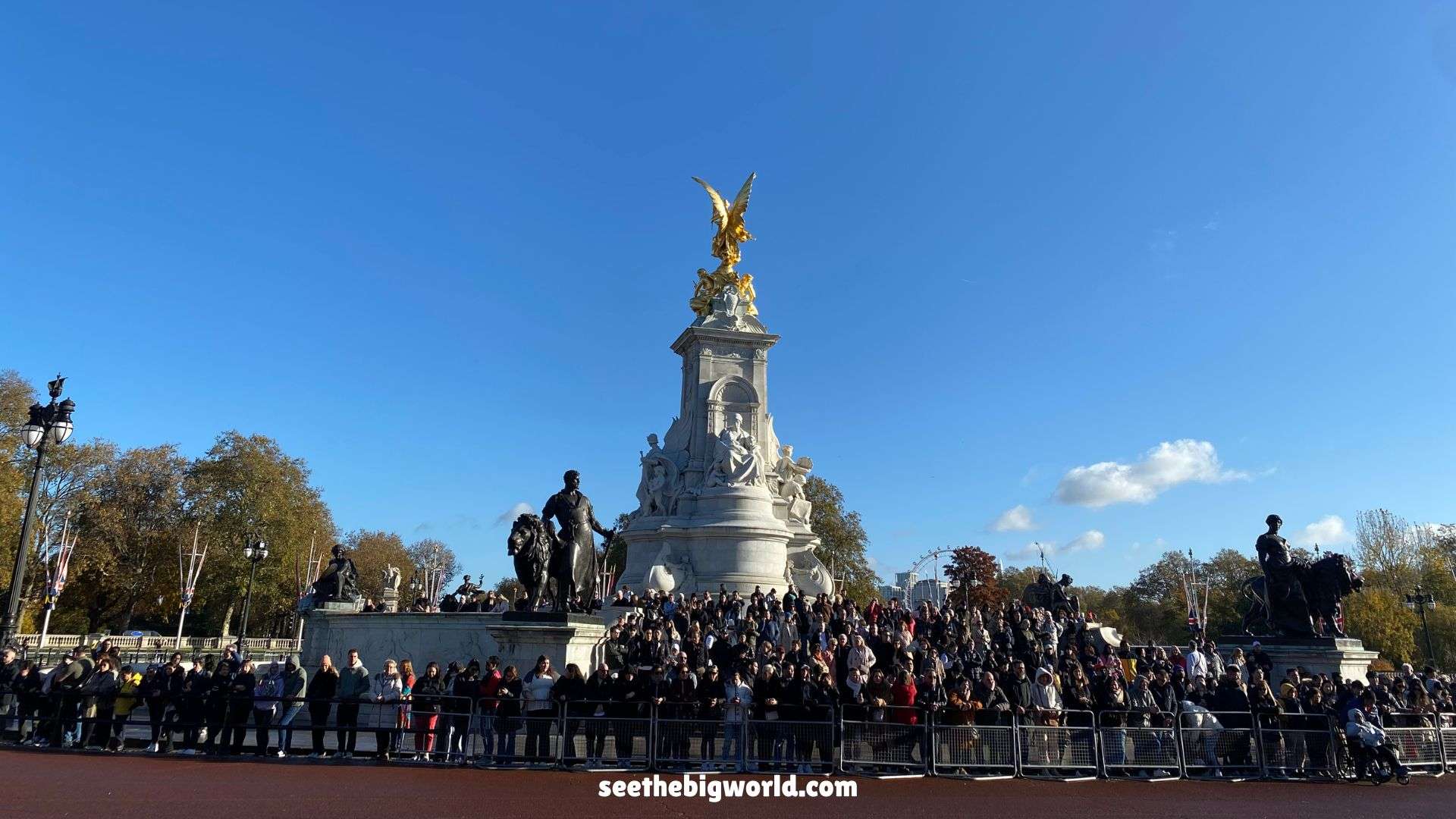
Victoria Memorial, directly opposite Buckingham Palace, offers a slightly elevated viewpoint from its steps and platform.(The red circle on the map above)
- Pros:
- You can capture the palace façade, the troops and the main square in one frame
- The height helps you see over the crowd in front
- Cons:
- You still need to arrive early and there are limited good spots
- Depending on the season and weather, some angles can be backlit, so you may need to adjust your position on site
- The distance is greater than at the railings, making it harder to capture close facial details
- Best For:
- Travellers who want wide shots and plan to edit Reels or Shorts
- Those who care more about the overall look of the scene than every small movement
Marching Guards: The Mall & Wellington Barracks
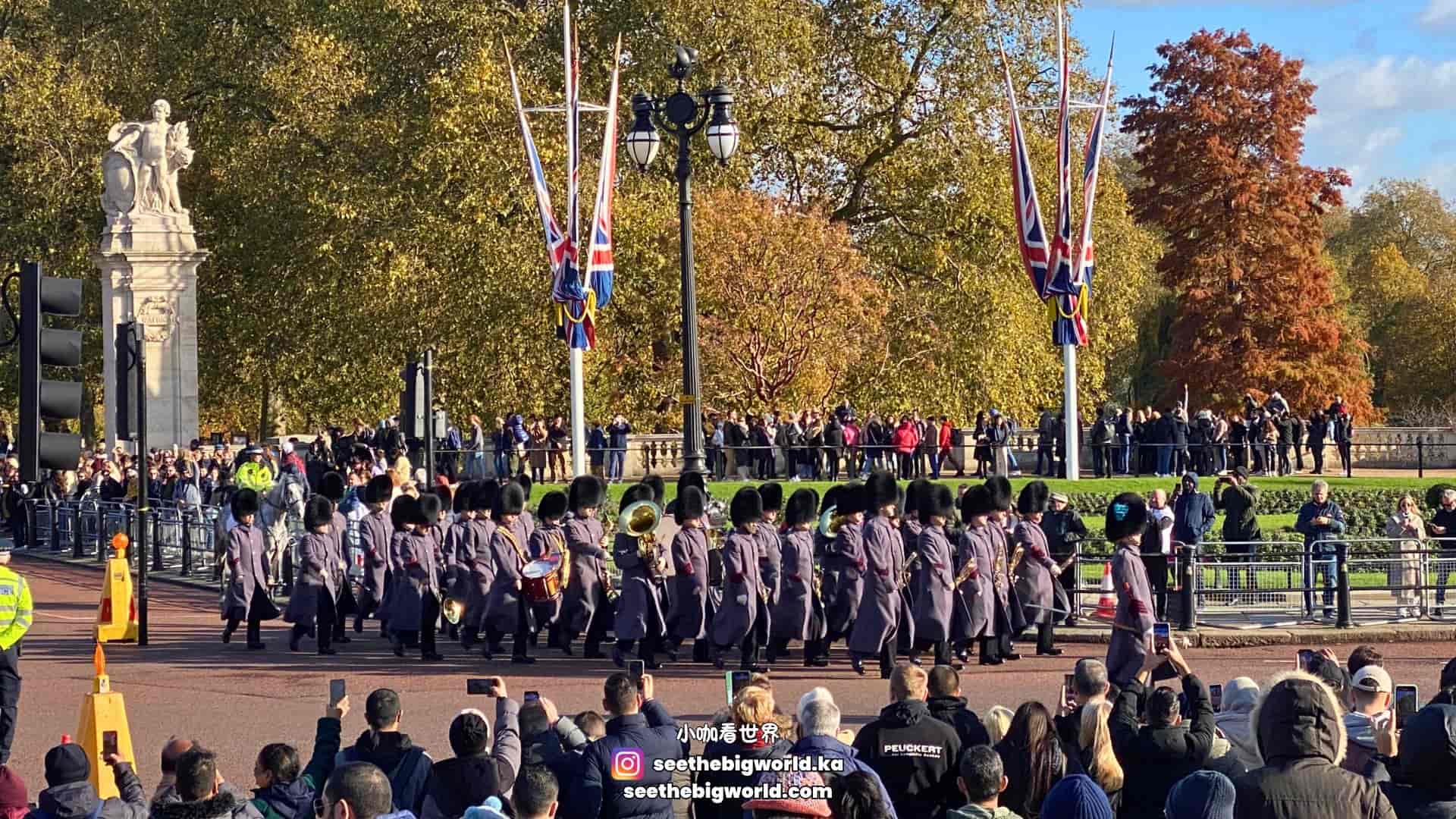
If you are more interested in “troops marching through the city streets”, you can stand at:
- The Mall (The yellow solid rectangle on the map above)
- The marching route around Wellington Barracks (The pink solid rectangle on the map above)
At these locations, you will see:
- The band and guards marching in formation as they arrive and depart
- How spectators, police and traffic control actually operate along the streets
- How the ceremony is embedded in London’s daily traffic and rhythms
These spots are generally better for those who have already watched the main ceremony once and, on a second visit, want to observe the atmosphere from a broader city perspective.
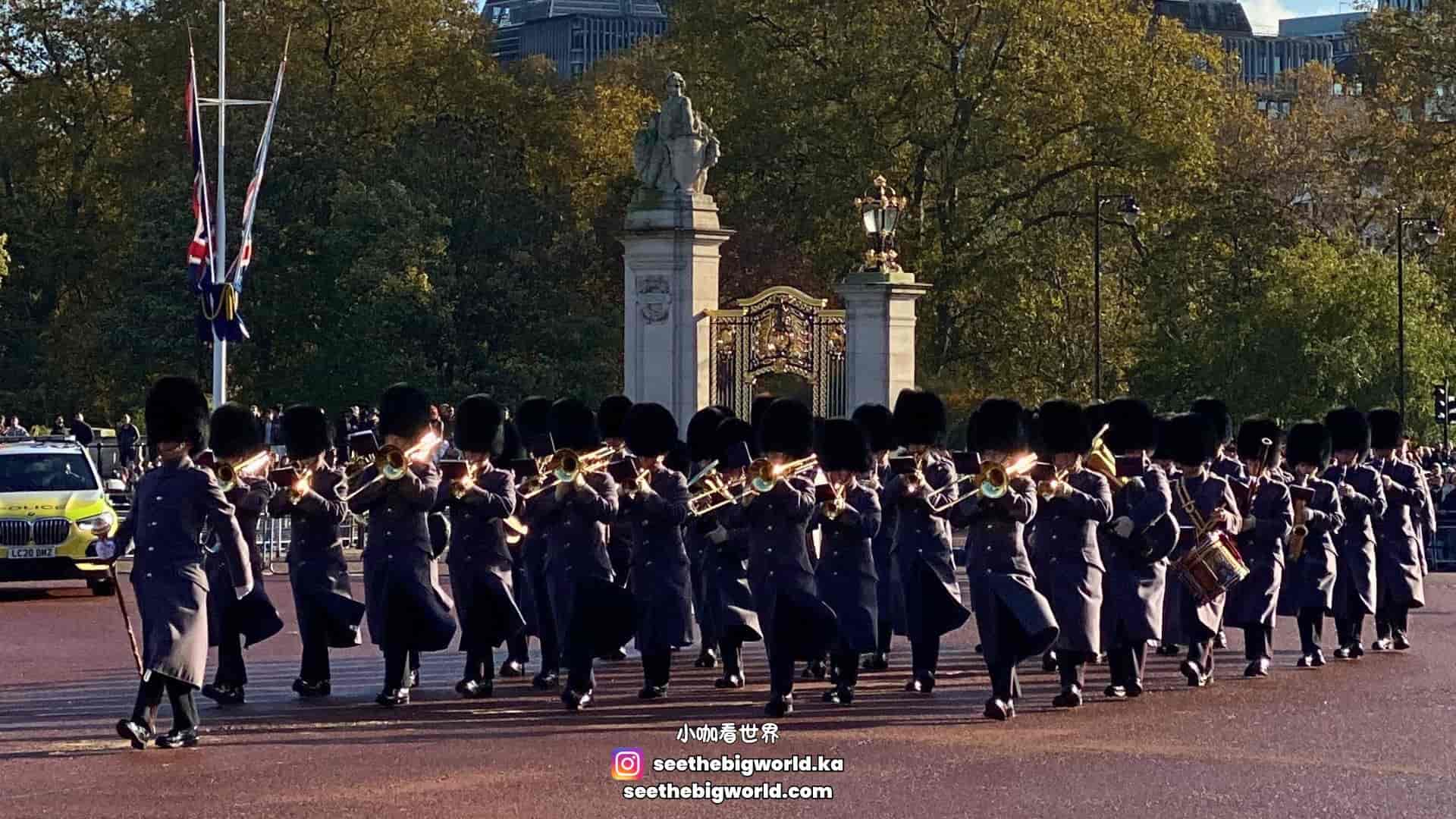
Best Spots with Seniors or Kids
If someone in your group is not suited to standing for long periods in a tightly packed crowd, consider:
- Standing along the edges of St James’s Park where you can still see the troops marching, but crowds are usually thinner than directly in front of the palace
- Avoiding spots where you must stand and there is nothing to hold on to, such as the edges of very high steps
- Agreeing in advance which direction you will move if you decide to leave, so you are not pushed back towards the palace by the crowd
Best Exit Routes
Crowds are usually densest in:
- The square directly in front of Buckingham Palace
- Around the steps of Victoria Memorial
- The palace end of The Mall
After the main ceremony, head towards St James’s Park rather than The Mall, as it’s usually easier to get out that way; if you are going on to Westminster Abbey, walking around the park is generally smoother than squeezing into the Tube.
Nearby Sights & Rainy-Day Plan
Whether or not the ceremony goes ahead, the area around Buckingham Palace works well as a complete morning walk; the focus just changes slightly.
If the ceremony takes place as planned, you can structure your day like this:
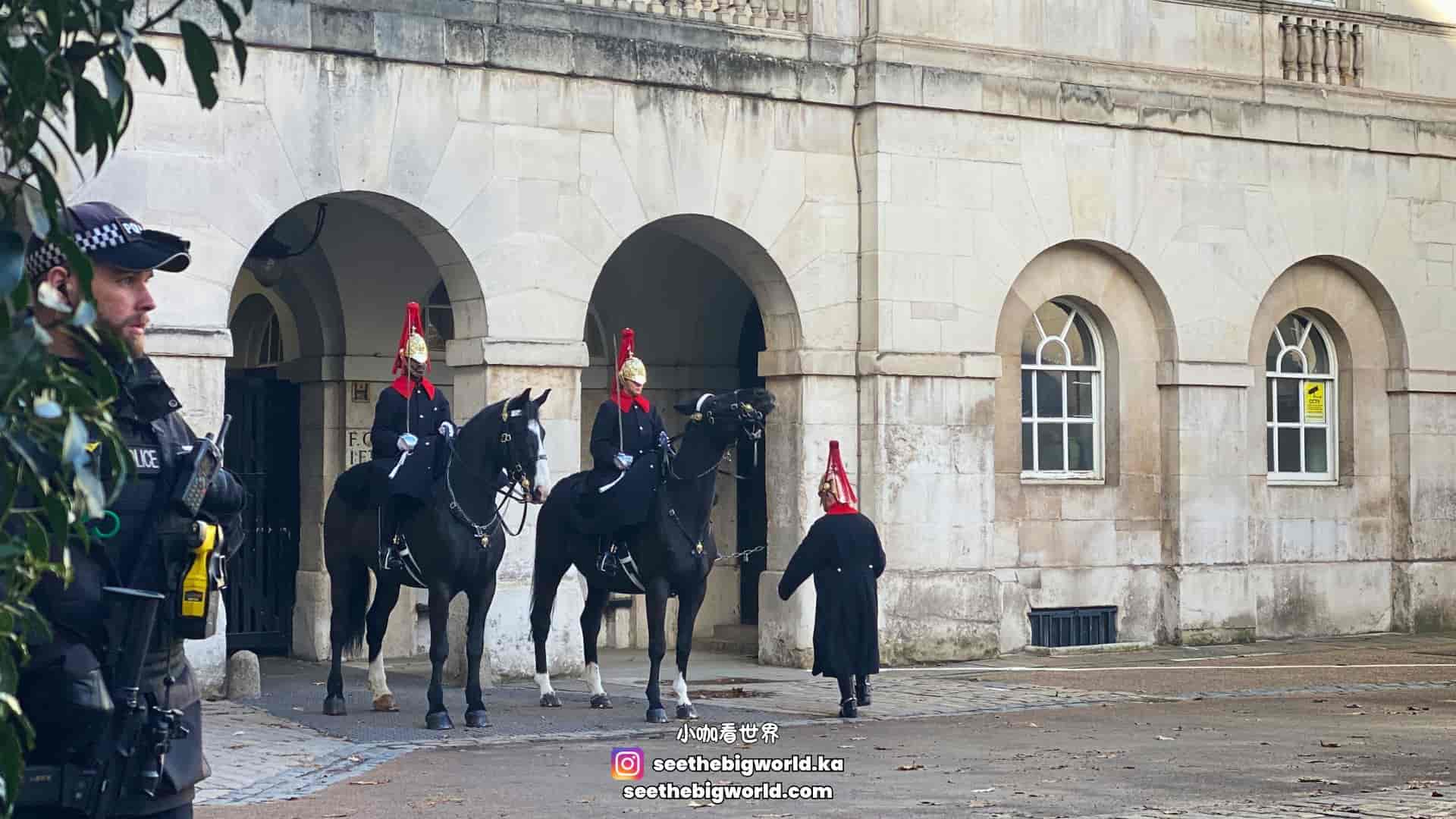
- Buckingham Palace guard change → walk through St James’s Park → continue to Horse Guards Parade near the north-east corner of the park by Whitehall (you can see the Household Cavalry here, usually with fewer crowds than at Buckingham Palace) → walk on towards the Westminster area → follow Birdcage Walk or the paths in the park to reach Big Ben, photographing Parliament and the riverside on the way → visit Westminster Abbey or the Houses of Parliament in the afternoon → end the day with a stroll or boat ride along the Thames, covering the classic sights in this area.
If heavy rain, slippery ground or special military or state events cause the ceremony to be reduced or cancelled, your morning is still not wasted. You can immediately switch to:
- A Westminster day plan:walk straight to Big Ben and Westminster Abbey and focus on indoor sights and river views; or
- A park + indoor plan:take a short walk in St James’s Park, then move into a nearby museum or gallery to shelter and rest.
The benefit of this approach is that, even without the full ceremony, you still spend that time walking through the political and royal core of London. Your morning remains full and coherent; you simply shift from “ceremony watching” to a mix of city walk and nearby sights.
Change of Guard FAQ
How long does the ceremony take?
The ceremony itself lasts around 40–45 minutes. However, if you include arriving early to wait and the time needed to leave with the crowds afterwards, it will realistically take about 2 hours in total.
Is there a big difference between summer and winter?
Yes. In summer, the days are longer, the crowds are noticeably heavier, and the ceremony may take place more frequently. In winter, there are fewer ceremonies, the weather is colder and daylight is shorter, but the crowds are usually less intense. It really depends on whether you are comfortable standing in the cold for an extended period. In winter the guards often wear grey greatcoats, so if you specifically want photos of the classic red tunics, you will have better chances in summer or during warmer months.
Is it too tiring for children or older travellers?
As long as everyone is mentally prepared to stand for a while, and you remember to drink water and step away from the densest crowds when needed, it is manageable. The key is not to force your way to the very front by the railings, but instead choose a spot with a reasonable view that is also relatively easy to enter and exit.