If you are planning a trip to London and want to see a musical in the West End, wondering how to buy tickets, where to find cheaper seats, and how to choose between Stalls, Circle and Balcony, this guide walks through the main ticket options, a West End must-see show list, and explains the view and price differences between each seating level.
Read More
Passes:London Pass|BritRail Pass|Euro Train Pass
London Articles:London Travel Guide|London Pass Guide|London Itinerary|London for Seniors|London Transportation Guide|Top Things to Do in London|Buckingham Palace Changing of the Guard|Westminster Abbey|St Paul's Cathedral|Tower of London|Day Trip to Greenwich|Harrods|West End Musicals|London Skyline
Other UK Cities:Cities Near London|Liverpool Guide
London West End Must-See Shows
The reason the West End became one of the world’s theatre capitals is not only because the productions are excellent, but also because it is a mature commercial ecosystem shaped over several centuries of evolution. To understand the West End today, you need to examine it within the dual context of historical power and modern economics.
The formation of the theatre district is, in essence, a history of bargaining between British royal power and entertainment capital. Its origins can be traced back to the mid-17th century, when, following the Restoration of Charles II, the king issued the rare “Royal Letters Patent”, allowing theatre companies to be established. The Theatres Act 1843 broke the monopoly that a small number of patent theatres held over “legitimate drama”, leading to a surge in theatre numbers, while the business model shifted from serving royalty to serving mass entertainment. Walking through Shaftesbury Avenue or Covent Garden today, you are witnessing the historical continuation of a system moving from chartered privilege to free competition.
Classic Long-Runners for First-Time Visitors
If you only see one show in the West End in your life, you won’t go wrong starting with a classic long-running production. These works have long outgrown the category of “just a show”; they are the industry’s living shopfronts.
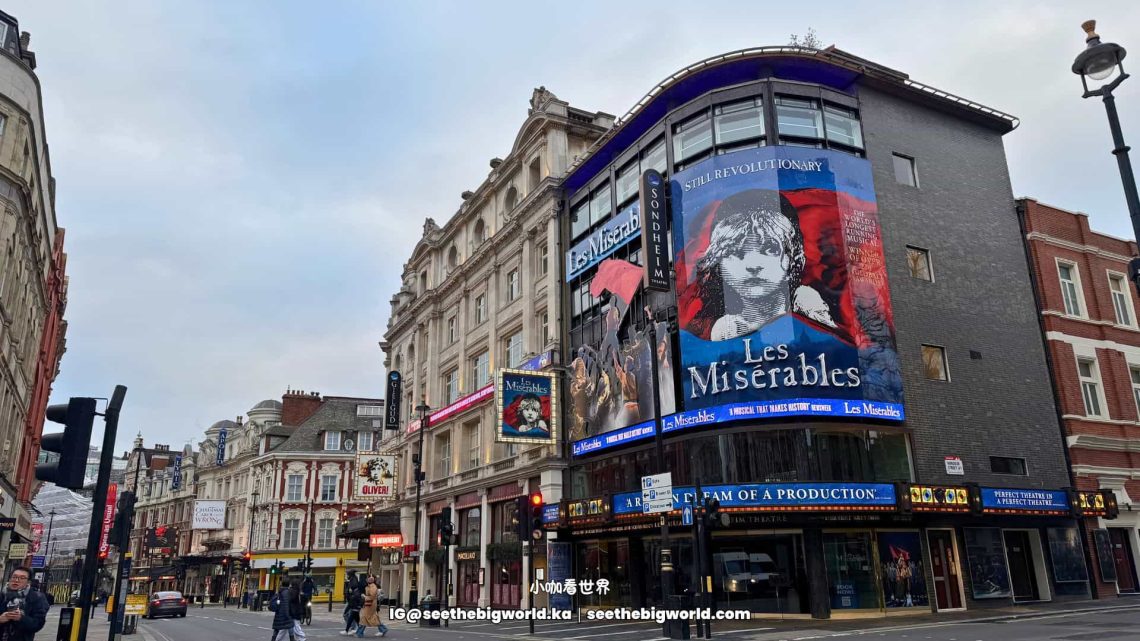
- Les Misérables @ Sondheim Theatre
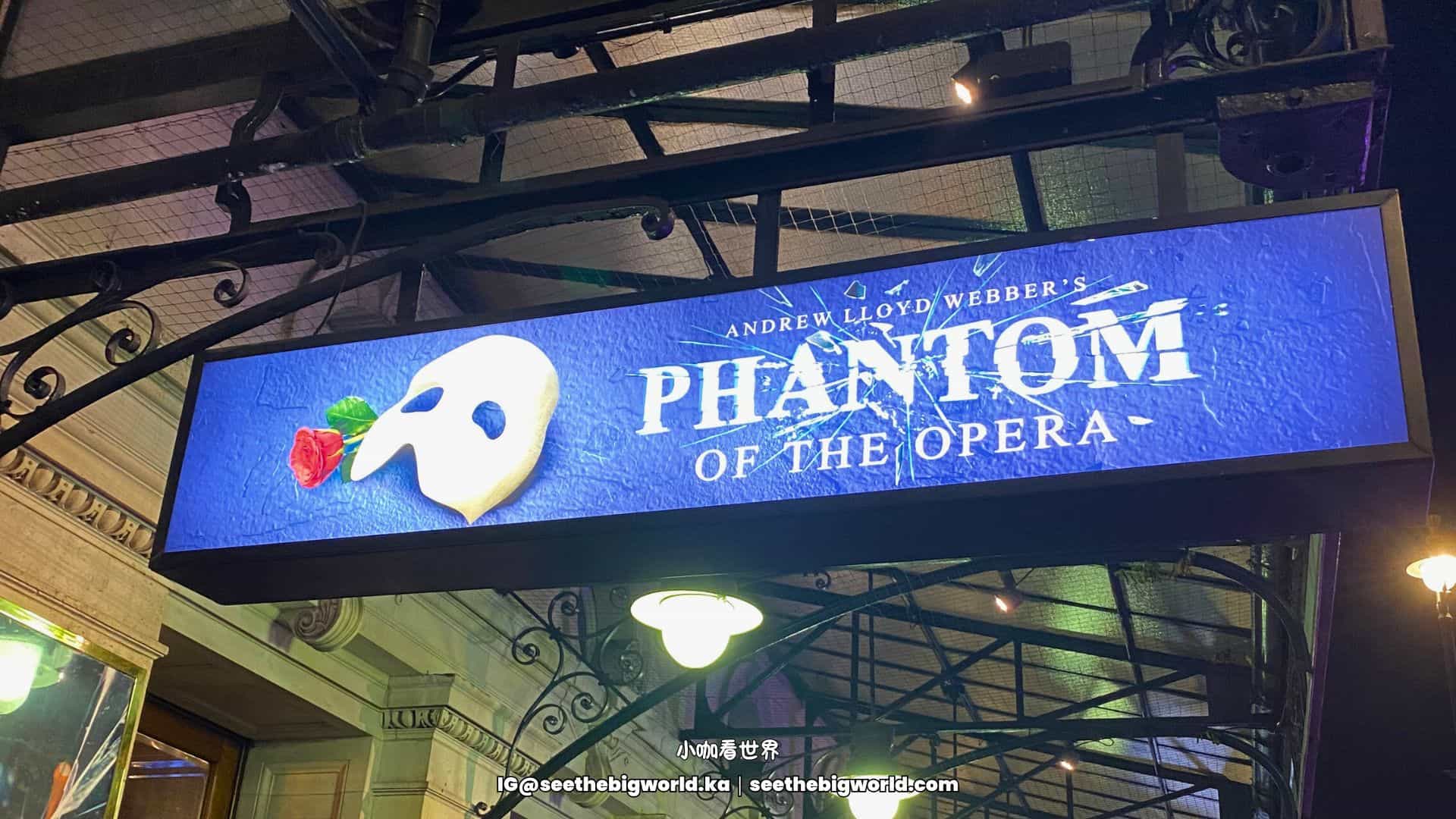
- The Phantom of the Opera @ His Majesty’s Theatre
- The Lion King @ Lyceum Theatre
Big Spectacle Musicals for Pure Fun
Some evenings, you simply want your brain to stop working for a while and enjoy a full dose of pop songs and feel-good energy. These productions do not require special homework, making them perfect as a “switch-off slot” during a trip.
- Mamma Mia! @ Novello Theatre
- Back to the Future@Adelphi Theatre
Story- and Music-Heavy Picks
If you usually prefer works with high narrative density and complex emotional layers, consider shows that are “heavier” in both script and music. They may not always suit first-time musicalgoers, but they are highly rewarding for people used to theatre.
- Hamilton @ Victoria Palace Theatre
- The Book of Mormon @ Prince of Wales Theatre
Family-Friendly Shows for All Ages
When taking children or older family members to a show, what you need is visual impact and a clear storyline, ideally something you can fit into the middle of your itinerary. When choosing, prioritise productions labelled “Family Friendly”.
- Matilda The Musical @ Cambridge Theatre
- Wicked@ Apollo Victoria Theatre
- Disney’s Hercules @ Theatre Royal Drury Lane
Seats and Views: Stalls, Circle or Balcony?
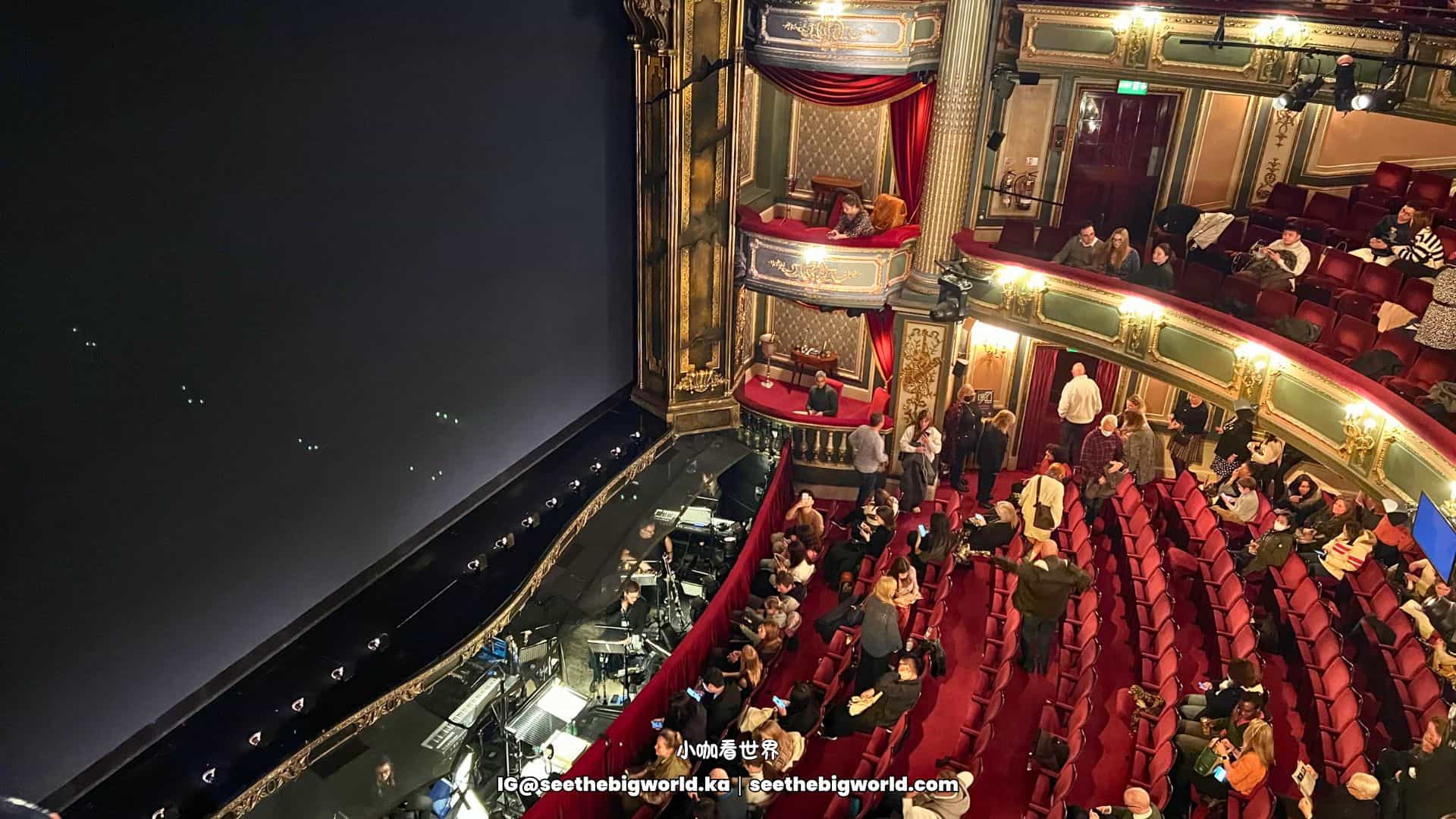
Watching a show in London is never just about watching what is on stage; it is about stepping into a preserved time capsule. Many West End theatres, such as His Majesty’s Theatre, are legally protected historic buildings (Listed Buildings). Even without seeing a show, the ornate ceiling plasterwork and the deliberately preserved red carpets are historical traces in themselves. But because the building structures cannot be altered, limited legroom is the norm.
The West End ticket pricing structure demonstrates an extreme form of “price discrimination”, and the experience of different seats reflects a direct kind of class logic:
Stalls: Most Immersive, Closest to the Stage
The Stalls are the ground-floor seats closest to the stage. From here you can see facial expressions, costume textures and small movements clearly. You feel the physical presence and energy of the performers in a way upper levels simply cannot match. For visually rich shows with big sets and effects, such as The Lion King, the Stalls can feel overwhelmingly immersive.
- Cons: Your sightline can easily be affected by the height of the person in front; seats that are too close to the front may require you to look up for the entire show, which is not particularly friendly on the neck.
- Positioning: One of the higher-priced areas. Suitable for people treating this as a “key investment night” during a trip and wanting to be properly hit in the face by the music and performance.
Dress / Royal Circle: The Best Balance
The Dress Circle or Royal Circle sits in the mid-upper part of the theatre and is often considered the most balanced viewing area. At this height, you are not too far from the stage, while still being able to see blocking, formations and lighting design clearly, making it well suited to ballet and large ensemble choreography.
- Positioning: Usually falls into the mid-price range, neither the most expensive nor the cheapest, and is a recommended choice for beginners starting their West End theatre experience.
- Note: Naming conventions are not exactly the same across theatres (some call it Dress Circle, some Royal Circle). For the actual height and view, always check the theatre’s official seating plan.
Upper / Grand Circle: View vs Comfort Trade-Off
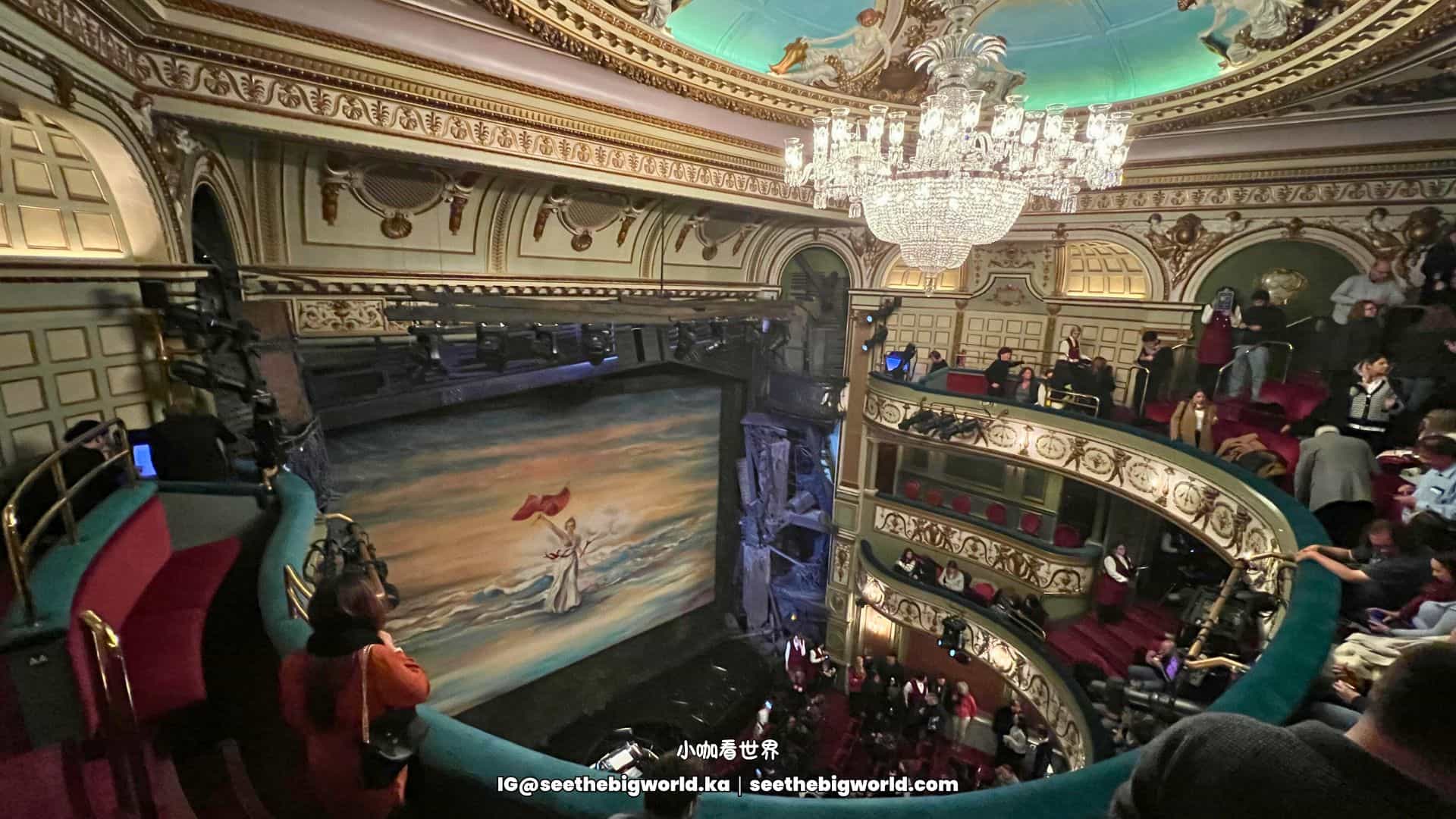
Go one level higher to the Upper or Grand Circle, and you enter true “look-down-over-the-whole-stage” height. From here, you can take in the full stage composition in one glance. The cost of that distance, however, is that actors’ expressions and details depend heavily on your eyesight and the size of the theatre.
- Cons: Common problems on the third level of old theatres include very tight legroom, upright seats and steep stairs. Not very friendly for people with a fear of heights or limited mobility.
- Positioning: A compromise option for “limited budget, but not wanting to move all the way to the very top”.
Balcony / Gallery: Cheapest Seats, Highest View
The Balcony or Gallery is at the very top of the theatre, with a very high viewing angle. It suits audiences who mainly care about hearing and the overall visual experience, rather than detailed facial expressions or fine-stage detail.
- Cons: Seats are more cramped, airflow may be poorer, and it is not recommended for people who are afraid of heights, prone to dizziness, or who need a more comfortable environment.
- Positioning: Suitable for very tight budgets, repeat viewers, or first-timers trying a London theatre experience.
Where to Buy West End Tickets for Less
Once you have worked out what you want to see and what kind of seat view you want, the next question is: where should you buy?
Many travellers assume musicals are an expensive activity, largely because Asia relies on overseas touring productions, where high logistics costs push ticket prices up. But in London, the West End is a highly industrialised cluster. Classic shows such as The Phantom of the Opera have been running for decades, and their upfront costs were recovered long ago. This allows theatres to lower the entry threshold to roughly two to three times the price of a cinema ticket (around £25 - £30), turning theatregoing into a more everyday form of entertainment.
Official Theatre Websites
In the West End, the safest way to buy tickets is to go straight to the “source” — the theatre itself. What you need to know is that most commercial theatres in London are owned by four major groups. As long as you confirm which theatre your chosen show is playing in and buy through that group’s official website, you can usually get the most transparent pricing and the most accurate seat information.
The four major theatre groups and their official ticketing systems are as follows:
- LW Theatres
- The group owned by musical theatre giant Andrew Lloyd Webber
- Owns landmark venues including His Majesty’s Theatre (The Phantom of the Opera) and Theatre Royal Drury Lane
- Its website interface is very intuitive and provides high-quality seat view previews
- Delfont Mackintosh
- The group owned by legendary producer Cameron Mackintosh
- Holds multiple super long-running hits: Les Misérables, Hamilton or Mamma Mia!
- Nimax Theatres
- Owns popular venues such as Palace Theatre (Harry Potter) and Vaudeville Theatre (SIX)
- ATG Tickets
- The UK’s largest theatre operator
- In addition to London venues such as Lyceum Theatre (The Lion King) and Apollo Victoria (Wicked), it also covers a large number of touring venues across the UK
Travel Booking Platforms
For travellers who do not want to repeatedly register accounts on the four theatre groups’ websites, or who feel uneasy about an all-English checkout process, integrated travel platforms such as GetYourGuide can be a very practical alternative.
- Pros: Although these platforms are resellers and offer less granular seat selection than official websites (you can usually choose a seating area rather than a specific seat), they make it much easier to book shows across different theatre groups in one place, without juggling multiple registrations and separate checkouts. For travellers, having tickets stored in one app is also more convenient; and if there are issues with booking confirmation, vouchers, or on-site coordination, platform customer service can often help contact the local service provider, which can save a lot of communication time during a trip.
- Best For: Travellers with tight itineraries who want to manage all travel tickets in one app, or short-stay visitors who are not picky about specific seats.
Day Seats, Rush and Lottery
If you are willing to accept the risk that “you may not get to see a show today”, or your itinerary is highly flexible, these mechanisms can let you buy excellent seats (often front rows) at very low prices (often under £30). At its core, this is a game of exchanging time for money.
- Digital Rush & Day Seats
- At the moment, the most mainstream low-price ticket tool in London is the TodayTix app. Many theatres release same-day leftover discounted tickets (Rush Tickets) through the app every morning (usually at 10:00 AM). You need fast fingers. If you get one, you pay in the app and collect your ticket directly, with no need to queue on site.
- Lottery
- For high-demand hit shows such as 《Hamilton》 and 《The Book of Mormon》, theatres set up lottery systems. You register via a designated website or app, and the system draws winners a few hours before the performance, allowing them to buy prime seats at “cabbage prices”. This is purely luck and cannot be forced.
- Physical Day Seats
- A small number of theatres still keep the traditional “queue at the box office” system. You need to queue outside the theatre before the box office opens (often early in the morning). In a cold London winter, this is a challenge — but it may also be the most “physical” way to guarantee you can get a ticket.
TKTS Booth in Leicester Square
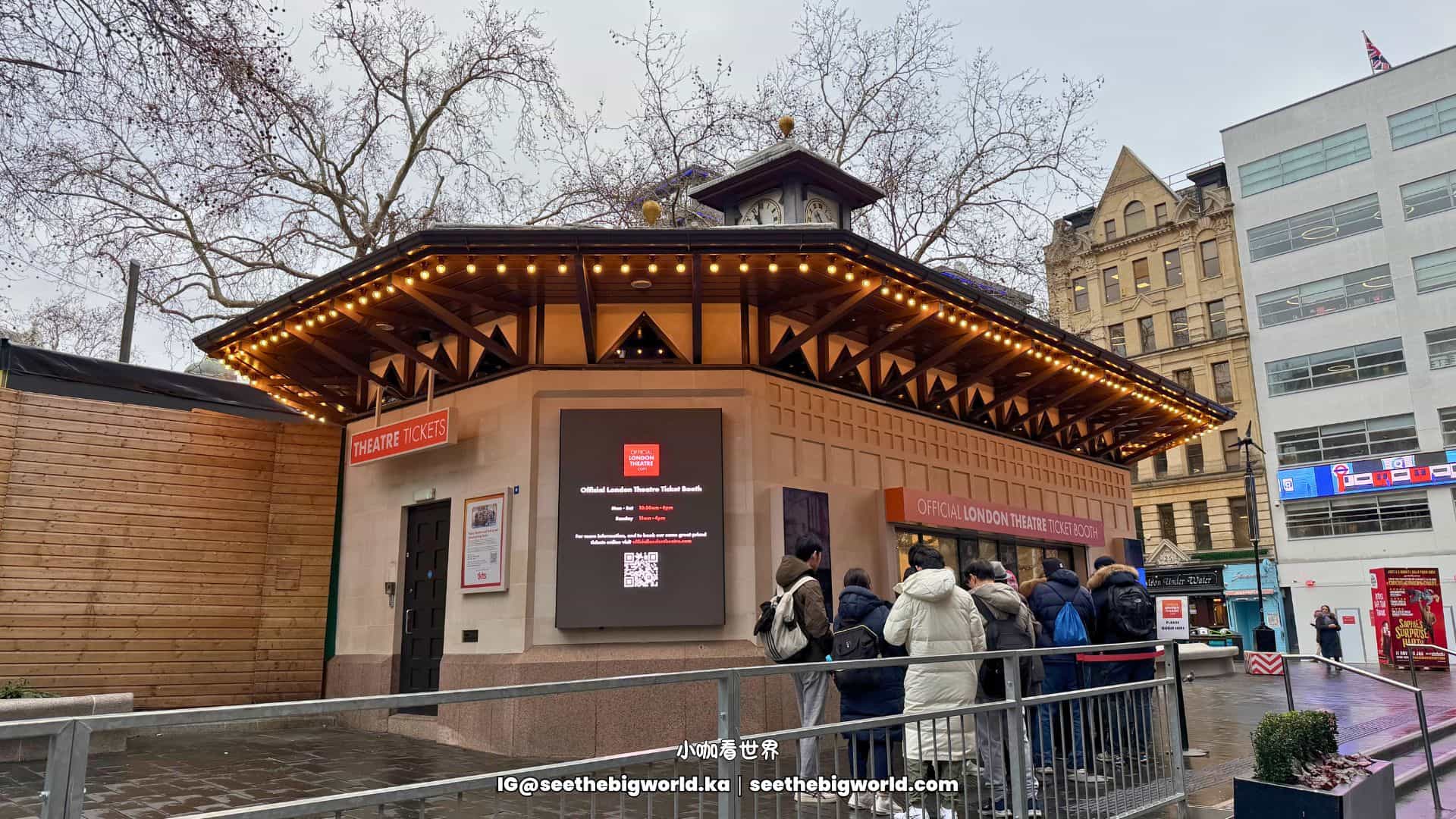
Located right in the centre of Leicester Square, the TKTS booth is officially operated by the Society of London Theatre (SOLT) and is a landmark of West End in-person ticketing.
- Positioning: It is not for buying hot tickets (shows like The Lion King rarely get discounted there). Its value lies in the “last-minute spontaneity”.
- Best For: If you happen to be near the West End and have a free evening slot but no specific target, it is worth checking the electronic board to see what still has availability that day. What this place sells is a very local experience: standing in the heart of London theatre and deciding on the spot which story to hear tonight.
My Tips for Choosing Seats Smarter
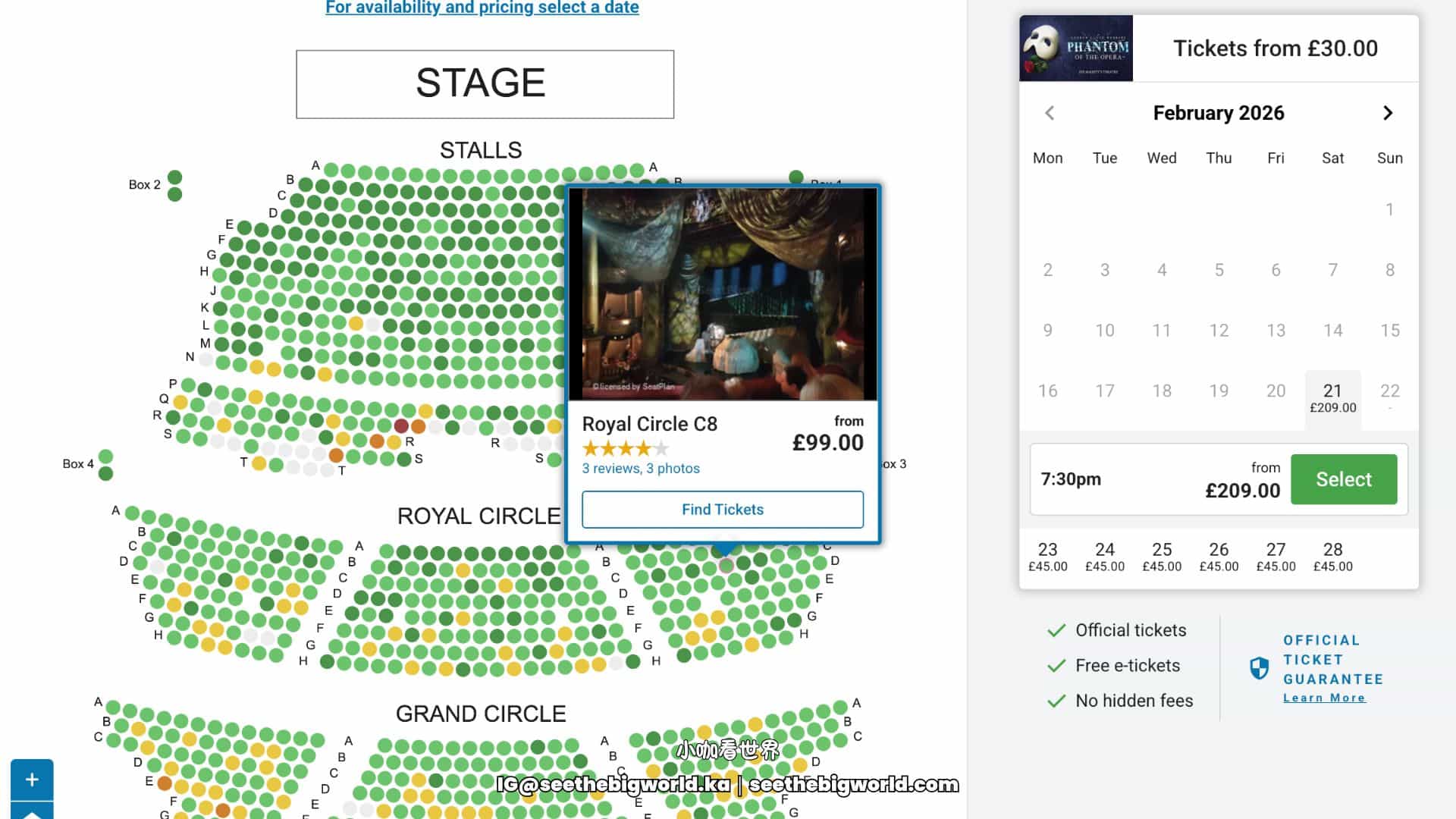
Check Real Seat Photos Before Booking
Flat seating maps on ticketing interfaces often fail to show 3D obstructions (such as railing height or the overhang pressure from the Circle above). I strongly recommend that after choosing a seat, you spend two minutes using the following resources to do a “visual confirmation”:
- Official View
- Some official ticketing systems provide a “blank stage view” image from the selected seat during seat selection. These images can accurately help you judge the distance to the stage, angle deviation, and whether the seat is near the centre.
- User Photos
- Third-party platforms like SeatPlan collect large numbers of audience-uploaded real photos. Although the image quality varies, these are often the most valuable reference, because they reveal blind spots not shown on official images — for example, “whether someone sitting in front will block your sightline” or “what the actual atmosphere looks like once the lights go down”.
Practical method: check the official image first to confirm distance, then use SeatPlan to confirm whether there are hidden obstructions. This step makes every pound you spend more precise.
When Restricted View Tickets Are Worth It
Many people skip tickets marked “Restricted View” immediately, but this is actually one of the biggest bargain zones in the West End. The definition of “restricted” is broad and can include railings, pillars, box edges, or partial stage obstruction.
The key to judging whether it is worth buying lies in the cost-performance calculation of “degree of obstruction vs. amount discounted”:
- When it is worth buying
- If the obstruction is only at the very top of the stage (for example, you simply cannot see the chandelier rise in The Phantom of the Opera, or cannot see the very top of the set), but it does not affect understanding of the core plot at all, and the ticket is £30-£40 cheaper than nearby seats, that is a very high-value choice.
- When it is not recommended
- If the obstruction cuts across the centre of the stage, or forces you to crane your neck sideways for the entire show, then no matter how cheap it is, I would not recommend buying it — unless you happen to have a stiff neck and need physical rehabilitation. Otherwise, saving £20 only to spend the whole performance staring at a 19th-century Victorian pillar is not watching a show; it is standing in the corner reflecting on your life.
How to Plan Your Theatre Evening
West End theatres are concentrated around Piccadilly Circus and Covent Garden. The most practical reminder: book dinner at least two hours before curtain-up. Do not underestimate the speed of food service in British restaurants, and do not underestimate how long theatre security checks and the women’s toilet queues can take. After the show, my favourite route is to stroll back towards Trafalgar Square for the night view — that is the most tasteful and unhurried London evening ritual.
London Musical FAQs
Can I bring food or drinks into the theatre?
Most theatres do not allow hot takeaway food or outside alcohol, but water is usually fine. Drinks at the theatre bar are often expensive, which is normal.
What happens if I arrive late?
You will usually be asked to wait outside until a suitable break in the performance (a latecomers’ point) before being allowed in. In some cases, you may have to wait until the end of an entire scene or act.
Do I need to exchange an e-ticket for a paper ticket?
Most theatres now accept mobile e-tickets, so you can usually enter by scanning the QR code on your phone.
What about large luggage and security checks?
Large bags and cabin suitcases are usually not allowed inside the theatre, and cloakroom/storage space is often very limited. It is best to leave luggage at your hotel or a station luggage facility first. Security checks mainly involve bag checks and metal items, so arriving 30–45 minutes early is recommended.